
A vehicle out of alignment rarely announces itself with a flashing dashboard light. Instead, it hints through small symptoms that drivers learn to ignore, dismissing them as quirks of the road or aging cars. Knowing the specific signs of misalignment, and acting on them quickly, can prevent the cascading damage of uneven tire wear, premature suspension failure, and degraded handling that turns a routine drive into a fight with the steering wheel.
The most obvious symptom is a steering wheel that is not centered when the vehicle is traveling straight on a flat road. Many drivers compensate without realizing, gripping the wheel slightly off-axis to keep the car going where they want. The right test is to find a quiet stretch of straight, level road, let the steering wheel settle on its own, and observe whether the spokes are level. A wheel cocked five or ten degrees off center indicates a toe issue, often caused by hitting a curb, a pothole, or replacing a tie rod end without realigning afterward.
Pulling is the second classic symptom. A vehicle that drifts to one side when the steering wheel is held loosely usually has a camber or caster mismatch left to right, though it can also indicate a tire problem such as a damaged belt or unequal pressures. The diagnostic test is to swap the front tires side to side and drive again. If the pull reverses, the issue is in a tire. If the pull stays in the same direction, alignment is the suspect. Persistent pulling forces the driver to apply constant torque to the steering wheel, which is fatiguing on long drives and dangerous if the driver lets go for any reason.
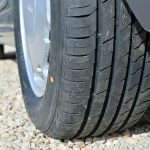
Tire wear patterns tell the story even when steering feel does not. The inner edge of a tire wearing faster than the rest signals excessive negative camber or too much toe-out. The outer edge wearing faster signals excess positive camber or toe-in. A feathered or sawtooth pattern across the tread, where the tread blocks have a sharp edge on one side and a rounded edge on the other, points specifically to a toe error and is one of the surest signs of needing alignment immediately. Center-of-tread wear comes from overinflation, both edges wearing equally come from underinflation, and cupping or scalloping comes from worn shocks or struts rather than alignment.
Vibration is more often a wheel balance issue than alignment, but a misaligned vehicle vibrates differently. Alignment-related vibration tends to feel like a low-frequency tugging or wandering rather than the high-frequency shake of an unbalanced wheel. If the steering feels twitchy at certain speeds, especially over crowned roads or rain grooves, the alignment may be wrong even if vibration is mild.
After any significant impact event, alignment should be checked. Hitting a deep pothole at speed can bend a tie rod, shift a control arm, or simply move the alignment outside its specifications. Curbing a wheel during parking is a classic culprit, especially on winter roads where snowbanks hide the actual edge. After accidents of any kind, even minor parking lot bumps, alignment is part of a thorough post-incident inspection. Shops sometimes detect bent components only after attempting an alignment and finding the adjusters at their limits.
Suspension and steering work always demands alignment afterward. Replacing struts changes camber and often caster. Replacing tie rods or rack and pinion components changes toe directly. Even ball joints and control arms shift the geometry. Lift kits and lowering springs require alignment because every angle moves with ride height changes. A suspension job without a follow-up alignment is incomplete and risks ruining the new parts indirectly through tire wear that signals continued problems.
Seasonal mounting of winter tires can also be a trigger for alignment, especially if the dedicated winter wheels have a different offset than the summer wheels. Some drivers report different handling between seasons not because of the rubber but because the alignment shifts subtly with the changed wheel package. A shop can record alignment readings with each set of wheels mounted, ensuring proper geometry year-round.
A less obvious symptom is degraded fuel economy. A vehicle dragging tires sideways at all times, even slightly, requires more energy to move forward. The losses are small but real, and they add up across thousands of miles. Drivers who notice their average fuel economy drift downward without explanation should consider alignment as one of the candidates, especially if combined with any of the other symptoms.
Steering wander is the symptom drivers most often blame on the road or the wind. A vehicle that needs constant small corrections to stay in its lane, especially on highways, may have low caster or a worn alignment-related component. Modern cars are designed to track straight with minimal driver input, and the need to constantly correct is a sign that something has shifted from factory specifications.
The right time to get alignment is at the first hint of any of these symptoms, not after waiting to see if they get worse. Tires worn unevenly cannot be saved by aligning afterward; the damage to the rubber is permanent. Catching alignment early protects the rubber and the suspension, and the cost of an alignment service is consistently among the best returns on investment in vehicle maintenance.