Wheel alignment is one of those vehicle maintenance topics that hides remarkable depth beneath a deceptively simple surface. Most drivers know that an alignment is something a shop performs after hitting a pothole or installing new tires, but few understand what is actually being adjusted, why those adjustments matter, and how the geometry of a vehicle’s suspension determines everything from tire wear to handling feel to fuel economy. The three primary alignment angles, toe, camber, and caster, each serve different purposes, and learning them transforms vague complaints about steering into specific diagnoses.
Toe is the angle of the wheels relative to the centerline of the vehicle when viewed from above. If both front wheels point slightly inward toward each other, the alignment has toe-in. If they point slightly outward, the alignment has toe-out. The amounts are tiny, often measured in fractions of a degree or in millimeters, but the effects are dramatic. Excess toe-in scrubs the outer shoulders of both front tires inward; excess toe-out scrubs the inner shoulders outward. Either condition can ruin a brand-new set of tires in a few thousand miles. The reason vehicles have any toe at all comes from suspension geometry that flexes under driving loads. Most front-wheel-drive cars are aligned with a small amount of toe-out at rest because the pull of the powertrain rotates the wheels slightly inward when accelerating. Most rear-wheel-drive cars use slight toe-in for the same reason, and rear suspensions almost universally use toe-in for stability.
Camber is the angle of the wheel relative to vertical when viewed from the front. Negative camber tilts the top of the wheel inward toward the engine; positive camber tilts it outward. Modern performance cars run noticeable negative camber, sometimes a full degree or more, because as the body rolls in a corner, the outside wheel rolls toward vertical and presents its full tread to the pavement. Without that initial negative camber at rest, the same wheel would tilt past vertical under hard cornering and ride on its outer shoulder, losing grip. Camber that is too negative wears the inside edge of the tire; camber that is too positive wears the outside edge. Camber differences left to right cause the vehicle to pull toward the side with more positive camber.
Caster is the most subtle of the three angles and the hardest to visualize. It is the forward or rearward tilt of the steering axis when viewed from the side. Imagine drawing a line from the upper steering pivot down to the lower one; if that line tilts rearward at the top, the alignment has positive caster. Positive caster creates self-centering behavior in the steering wheel, the same effect that makes a shopping cart caster wheel return to straight after being pushed sideways. Modern cars run substantial positive caster, often four to seven degrees, which is why steering wheels return smoothly to center after a turn. Caster also affects camber dynamically; as the wheels are turned, positive caster causes the outside wheel to gain negative camber and the inside wheel to gain positive camber, helping cornering grip without requiring extreme static settings.
Beyond these primary angles, alignment includes other parameters such as thrust angle, which describes whether the rear axle points straight ahead or off to one side, and ride height, which affects every other angle through the geometry of the suspension links. A vehicle with sagging springs measures different camber and toe than the same vehicle with fresh springs at correct ride height, even if no alignment work has been done.
The symptoms of misalignment vary by which angle is wrong. A pulling sensation usually points to a camber or caster mismatch left to right. A steering wheel that sits crooked with the vehicle traveling straight indicates a toe error or a thrust angle issue. Rapid tire wear on one edge points to camber; even wear on both edges points to toe. A vague, wandering steering feel often comes from low caster, while heavy steering effort can come from too much positive caster.
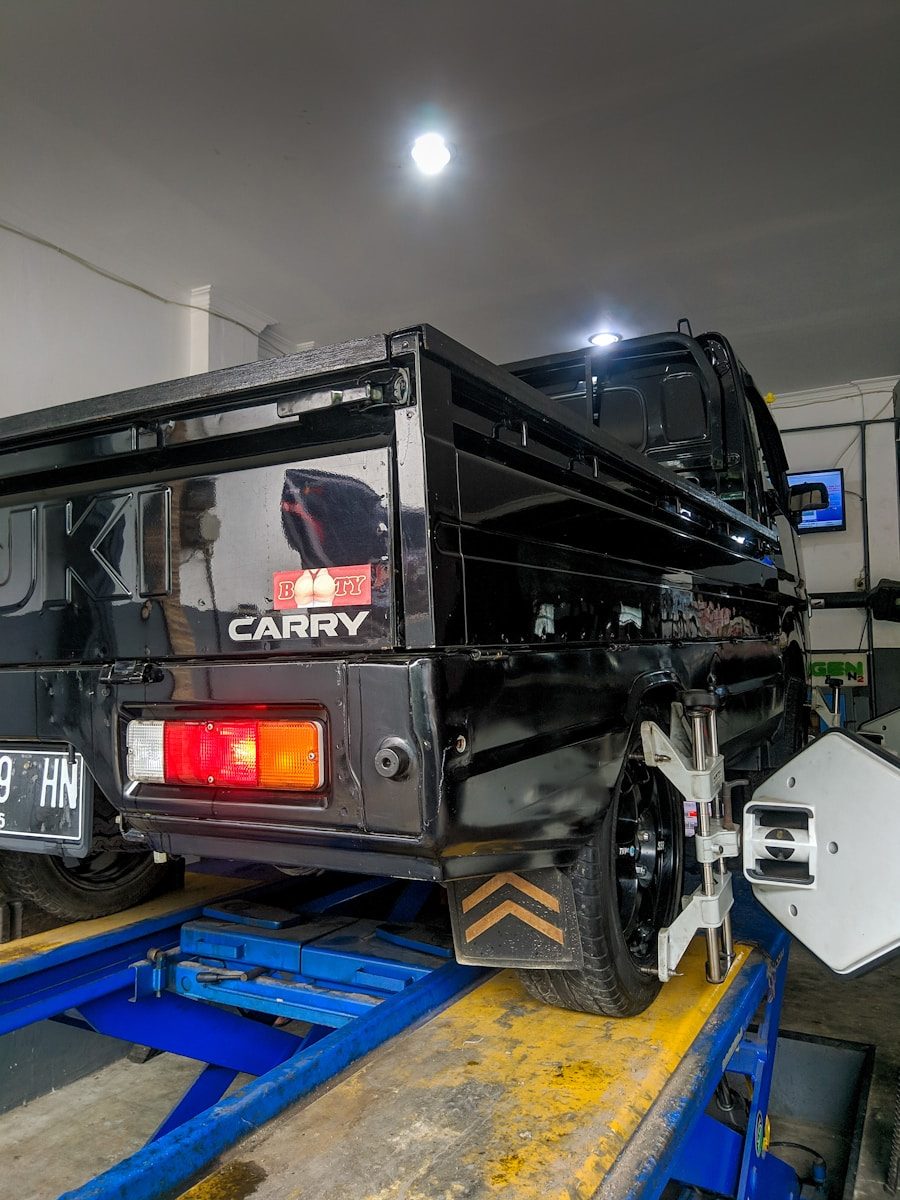
Modern alignment shops use elaborate equipment with cameras and laser sensors that measure all four wheels simultaneously, comparing actual readings to manufacturer specifications. The shop technician adjusts toe by turning tie rods, camber and caster by various means including eccentric bolts, shims, or special adjusters, and the equipment confirms the results with measurements down to hundredths of a degree.
Many factors disturb alignment over time. A serious pothole strike can knock toe and camber out instantly. Worn ball joints, tie rod ends, and control arm bushings allow the suspension to drift away from designed geometry. Lifted or lowered vehicles always need alignment after the change because every angle moves with ride height. After replacing struts, control arms, or steering racks, alignment is essential. Even tire wear can affect things; a heavily worn tire on one corner subtly changes the angles by lowering one corner.
Smart drivers schedule alignment as a preventive measure, not just a corrective one. Getting an alignment check once a year, ideally at the same shop with reference data on the vehicle, catches drift before tires pay the price. Shops that store before-and-after readings provide a record of how the vehicle is settling and what may need attention. The cost of an alignment is a fraction of a single replacement tire, and it pays for itself many times over in extended tire life, better fuel economy, and the simple pleasure of a vehicle that tracks straight, steers crisply, and feels predictable on every road.